The Impact of Motor Speed Frequency Adjustment on Energy Efficiency
Adjusting Motor Speed Frequency
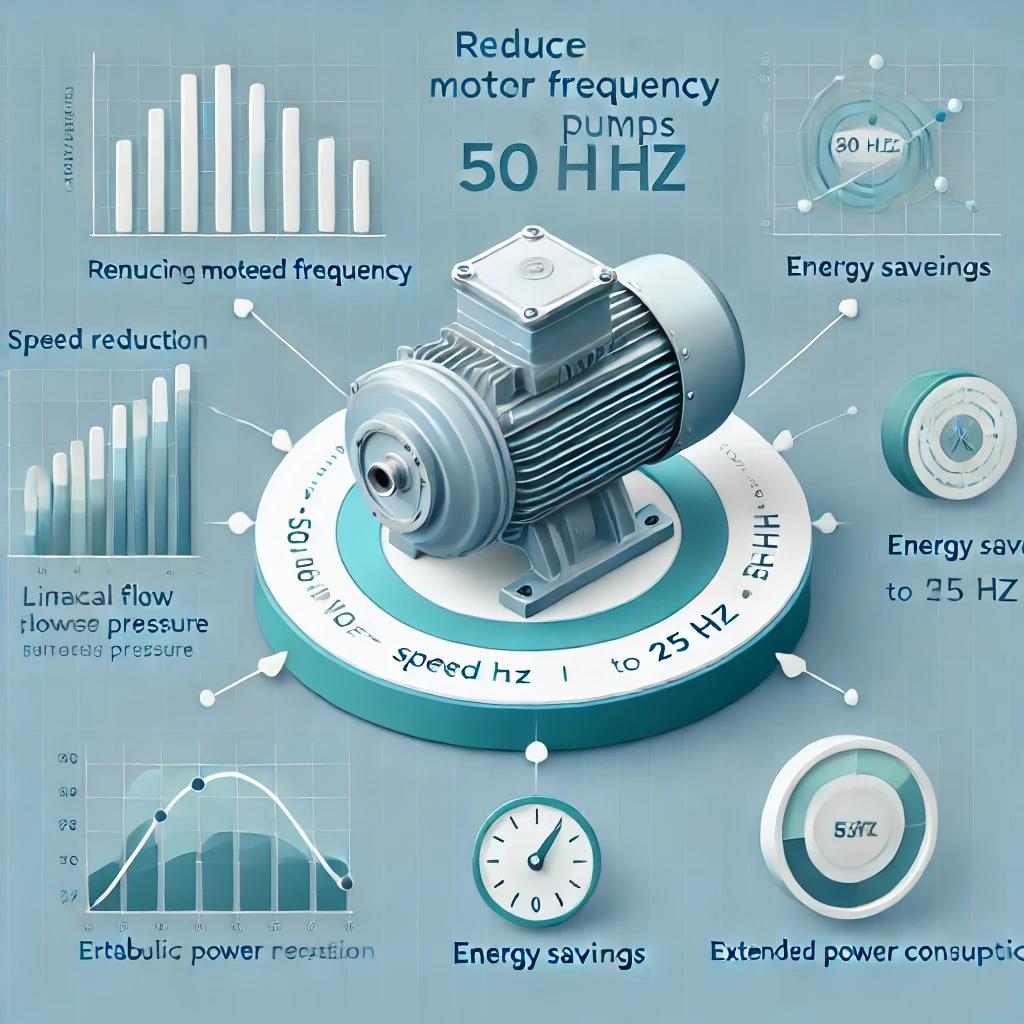
Reducing motor speed is an effective way to achieve significant energy savings. The main reason for this is that the energy consumption of a motor is proportional to the cube of its speed. For instance, when the speed of a motor running at 2950 RPM is reduced by 20%, approximately to 2360 RPM, the motor frequency decreases to 40 Hz, and energy consumption is reduced by 49%. Additionally, this speed reduction significantly extends the motor's lifespan.
Pump Performance and the Impact of Speed
Pump performance is directly linked to the pump’s rotaational speed. This relationship can be summarized as follows:
- Pump Flow Rate (Q): Linearly proportional to speed (1st-degree function).
- Pump Pressure (H): Parabolically proportional to speed (2nd-degree function).
- Pump Power Consumption (P): Cubically proportional to speed (3rd-degree function).
Even a small change in pump speed can cause significant differences in energy consumption. For example, reducing the motor speed from 50 Hz (2900 RPM) to 25 Hz (1450 RPM) results in:
- The pump flow rate being halved.
- The pump pressure decreasing to one-quarter of its original value at 50 Hz.
- The pump power consumption dropping to one-eighth of its original value at 50 Hz.
Thus, adjusting motor speed frequency to match system requirements plays a critical role in energy savings, enhances system efficiency, and reduces maintenance costs.