Use of Pumps in Negative Suction Conditions and Cavitation Prevention
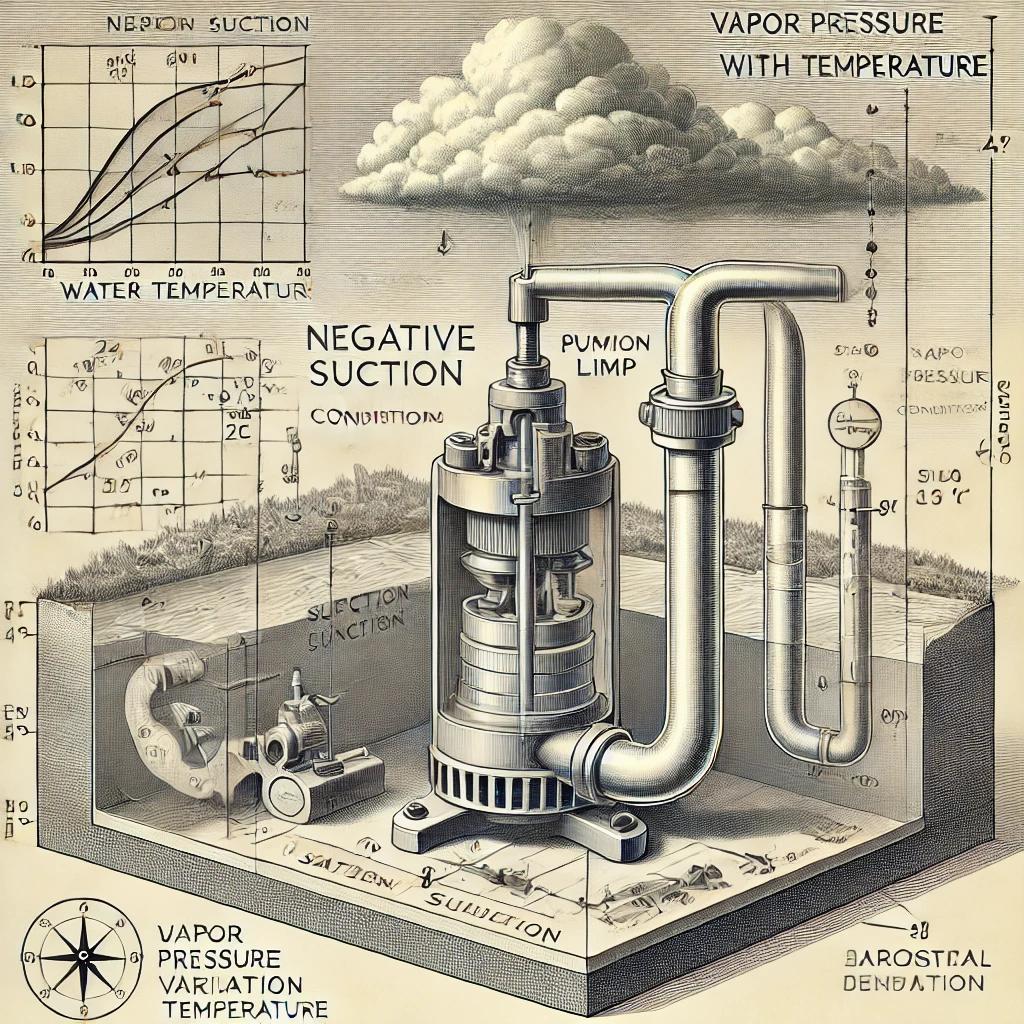
Determining Maximum Suction Depth (Z1)
To protect the pump from cavitation, the maximum suction depth (Z1) is calculated using the following formula:
Z1 = Pb – Required NPSH – Hr – pV
-
Pb: Barometric pressure (mSS). It decreases as altitude increases. (See Table 2)
-
Hr: Total transmission losses in the pump suction line (mSS).
-
pV: Vapor pressure (mSS). It varies with water temperature. (See Table 1)
-
Required NPSH: The net positive suction head at the pump's predicted operating conditions.
Vapor Pressure Table - Table 1
(A table showing vapor pressure variation with water temperature should be provided.)
Atmospheric Pressure Variation by Altitude - Table 2
(A table illustrating barometric pressure changes with altitude should be included.)
Example: Calculation of Net Suction Depth
Given values:
-
Q: 13 m³/h
-
NPSH: 4 mSS
-
Pb: 10.13 mSS
-
Hr: 2 mSS (Assumed approximately)
Calculation for different water temperatures:
-
T = 20°C, Pv = 0.22 mSS
-
Z1 = 10.13 - 4 - 2 - 0.22 = 3.91 m
-
-
T = 50°C, Pv = 1.147 mSS
-
Z1 = 10.13 - 4 - 2 - 1.147 = 2.98 m
-
-
T = 80°C, Pv = 4.67 mSS
-
Z1 = 10.13 - 4 - 2 - 4.67 = -0.54 m
-
Note: A safety margin of (-0.5 m) is recommended when determining the net suction depth.
Precautions to Prevent Cavitation in Negative Suction Conditions
-
Pump positioning: The pump should be mounted directly above the water reservoir and connected with a single elbow. (The suction line should be kept as short as possible.)
-
Suction line velocity: It should not exceed 1.5 m/s, considering maximum pump flow rate. The pipe diameter of the suction line should be determined based on maximum flow rate and velocity.
-
Straight-line design: The suction line should be as straight as possible, avoiding additional fittings such as filters and strainers that may cause local pressure losses.
-
Compliance with calculated Z1 value: The suction depth should not exceed the calculated Z1 value; otherwise, cavitation will occur.
-
Impact of water temperature: As water temperature increases, vaporization losses increase, reducing the net suction height the pump can achieve. (See example calculation.)
-
Altitude and atmospheric pressure: As altitude increases, atmospheric pressure decreases. Since Pb = 10.13 mSS at sea level, in higher locations, Pb should either be referenced from the table or roughly reduced by -0.5 mSS.